
What if we could reach panic
before panic reaches us?
There may be a moment before panic takes over.
Panic often feels as if it comes out of nowhere. But physiological arousal can begin building before a person consciously realises what is happening. That creates a potentially valuable window: a moment in which the body is already signalling change, while there may still be time to intervene.
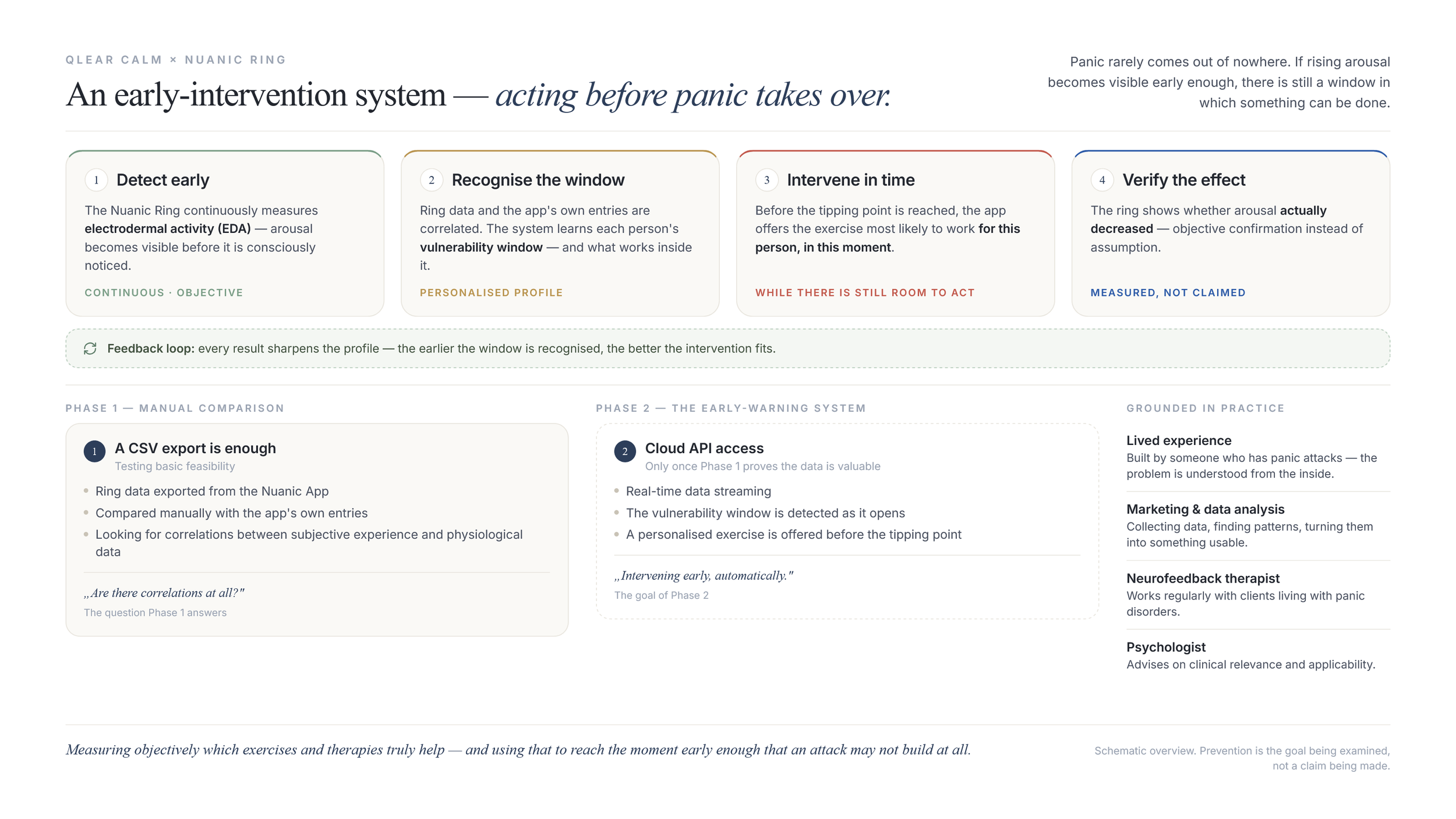
Qlear Calm is exploring whether the Nuanic Ring could help make this window visible. By combining continuous EDA data with simple moments marked by the user in the app — such as rising tension, early signs of panic or an actual attack — individual patterns may begin to emerge over time.
The idea is not to claim that panic can simply be predicted from one physiological signal. It is to learn what rising arousal looks like for this particular person — and whether that pattern can be recognised early enough to offer support before the tipping point is reached.
If such a window can be identified, the ring could do more than warn early. It could help Qlear Calm learn which exercises and therapeutic strategies actually appear to reduce arousal for this individual — and use that knowledge to make the next intervention more personal.
The first question is therefore deliberately simple: are the correlations there at all?
That is what Phase 1 is designed to find out.
Not only detecting the moment — but learning what actually helps
The same data could also help answer another important question: which interventions actually reduce arousal for this person?
Breathing exercises, grounding techniques and therapeutic strategies do not necessarily work in the same way for everyone — or in every situation. By looking at what happens physiologically before and after an intervention, Qlear Calm could begin to learn which approaches are associated with a measurable reduction in arousal.
Over time, this could create a highly personal feedback loop: detect the change, intervene, measure the response, learn from it — and use that knowledge the next time.
This would not replace a person's own perception or prove that a therapy is effective in a clinical sense. But it could add something valuable: an objective physiological perspective on what appears to help in the moment.
Why Nuanic?
For this idea, the quality of the physiological signal matters more than the number of features.
What makes Nuanic particularly interesting is its focus on electrodermal activity and sympathetic arousal — exactly the kind of signal that could help reveal changes before they are consciously recognised.
Qlear Calm already provides the other side of the equation: the person's own experience. A user can mark when early signs appeared, when panic occurred, which exercise was used and how the situation developed afterwards.
Bringing these two perspectives together — what the body measures and what the person experiences — could make it possible to identify meaningful individual patterns rather than relying on generic thresholds.
Start small. Learn first.
The first step does not require a real-time integration.
A CSV export from the Nuanic Ring would already allow us to compare physiological data with events recorded in Qlear Calm and explore a very basic question:
Can we see a recognisable pattern before moments of rising panic?
If the answer is yes, the next step becomes much more interesting: moving from retrospective analysis towards real-time detection — and eventually towards an intervention that arrives while there is still time for it to make a difference.
What I would like to explore with Nuanic
I would love to discuss whether Nuanic would be interested in supporting a small feasibility test — initially through access to exported data and, if the results are promising, potentially through API access at a later stage.
The goal is not to build another panic tracker.
The goal is to find out whether physiological data can help us reach the person earlier.